
Bullet train made in Qingdao breaks world record
Updated: 2010-09-29
|
|||||||||


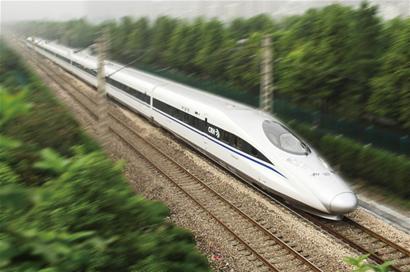 |
A new bullet train broke a world speed record during a trial run Tuesday.
The train, which ran from Hangzhou to Hongqiao, Shanghai and topped out at 416.6 kilometers per hour, was manufactured by CSR Qingdao Sifang Locomotive & Rolling Stock Co., Ltd., a Chinese rolling stock manufacturer based in Qingdao, Shandong peninsula.
"The one-way tour took no more than 40 minutes in the trial run,” a company representative said..
In June 2008, China’s “Harmony” bullet train broke the world’s highest train speed record when it reached 394.3 km/h on the Beijing-Tianjin intercity high-speed rail. This time, the bullet train made in Qingdao became the second Chinese-made train to brake the world record, marking another Chinese breakthrough in the world’s high-speed train history.
The design of this high-tech train incorporates technical aspects of railway travel, aviation and road transportation with capacities that can cater to the needs of many passengers.
The train, after leaving the Shanghai Hongqiao Railway Station on June 28, reached a speed of 300km/h within six minutes.
It took the train 14 minutes to finish the 202-kilometre trip from Shanghai to Hangzhou. The train broke the record at 11:37 am when the train was heading back to Shanghai after a three-minute break in Hangzhou.
Liu Zhijun, minister of China’s Ministry of Railway, once said that China would develop its own high-speed railway technology and lead a trend for the development of the world’s high-speed trains, leaving a tangible legacy for the next generations.
Officials with the Chinese railway system has used advanced technologies from abroad and created their own technology in recent years, which has helped them overcome numerous obstacles during the construction process of the high-speed, plateau and high-loaded railways.
In 1964, the Japanese Shinkansen bullet train system was put in to use in Tokaido, which was the first high-speed railway system with an average speed exceeding 200 km/h. Japan is home to2,340 km of high-speed railway, and there are 580 km of track under construction. Japanese officials have long-term plans for a high-speed railway system of 4,300 kilometres.
The European high-speed railway system now has 1,700 km of track, and officials plan to construct a total of about 12,000 km by 2020. TGV (Train a Grande Vitesse), the French high-speed train, and the high-speed ICE train in Germany can reach speeds of 300 km/h.
There are 13,414 km of high-speed railway in 14 countries and regions around the world.
Tthere are 7,055 km of railway in operation in China, which is the most in the world. The Chinese high-speed railway system -- with its advanced technologies, highest passenger capacity and operation speed and large scale -- has become a leader in the world’s high-speed industry.
The 202-km-long Shanghai-Hangzhou high-speed train, with the designed speed of 350 km/h and an expected capacity of 16 million passengers each year, starts at Shanghai Hongqiao Railway Station and ends at Hangzhou East Railway Station, with stops at Minhang, Songjiang, Jinshan districts in Shanghai and Jiaxing, Hangzhou in Zhejiang province.
"The Shanghai-Hangzhou high-speed train can separate the passenger transport from the goods transport and can also ease the over-loaded transportation pressure in China to give great momentum for the social and economic development in the Yangtze River Delta region. It plays an important role in the formation of a balanced pattern in our country’s regional economic, political, cultural and social progress. ” Minister Liu said.
The Shanghai-Hangzhou high-speed railway and other intercity railways in the Yangtze River Delta region, including the Beijing-Shanghai high-speed railway and the Shanghai-Wuhan-Chongqing railway, weave into a high-speed radiating passenger transport network, which is the main contributor to China’s overall railway transportation system.
By Audrey and Chen Zhilin