

Qingdao conference pushes innovation in low-carbon heating, energy storage
Experts and government officials gathered in Qingdao, Shandong province, on Jan 26 to discuss how environmentally friendly energy and energy storage systems can reshape district-level cooling and heating, as China pushes to meet its carbon reduction goals.
The meeting brought together representatives from the National Development and Reform Commission, the Ministry of Ecology and Environment, local governments, universities, research institutes and financial institutions.
Discussions centered on how technological innovation and market mechanisms can work together under China's "dual-carbon" goals to improve the efficiency, stability and sustainability of urban heating and cooling systems.
Participants examined future pathways for replacing coal-fired heating with renewable energy and for increasing the use of clean power in district energy networks. They also explored how energy storage can help balance supply and demand and make the large-scale application of green heating more reliable.
During the event, the Energy Research Institute of the National Development and Reform Commission launched a research project on the large-scale use of environmental energy in heating and its integration with renewable power consumption. The study aims to offer practical models for companies and provide policy references for improving subsidies and market mechanisms, supporting the development of a greener national heating system.
Su Wei, executive vice-chairman of the China Center for International Economic Exchanges, said China has established a comprehensive policy framework for its carbon goals and now leads the world in renewable energy capacity, adding that national energy governance is shifting from controlling total energy use to focusing more on carbon emissions.
He highlighted Qingdao's advantages in energy resources, industry and location, saying the city could promote citywide and county-level substitution of traditional heating with clean alternatives, build zero-carbon industrial parks and ports, and serve as a testing ground for green transformation.
"Qingdao could further expand green cooperation through the Shanghai Cooperation Organization," he added, considering the city is home to the China-SCO Local Economic and Trade Cooperation Demonstration Area.
The event was organized by the Development and Reform Bureau of Jiaozhou and co-hosted by institutions including the College of New Energy at Harbin Institute of Technology (Weihai), the Harbin Institute of Technology Qingdao Innovation and Development Base, Qingdao KC Blue New Energy Co Ltd, and Qingdao Shoujianxing New Energy Co Ltd.
After the meeting, Qingdao KC Blue New Energy Co Ltd and Qingdao Shoujianxing New Energy Co Ltd signed strategic cooperation agreements with China Railway 25th Bureau Group Corporation Limited, the Shandong Circular Economy Promotion Association, Beijing Gas and Heating Engineering Design Institute, and Zoolon Technology.
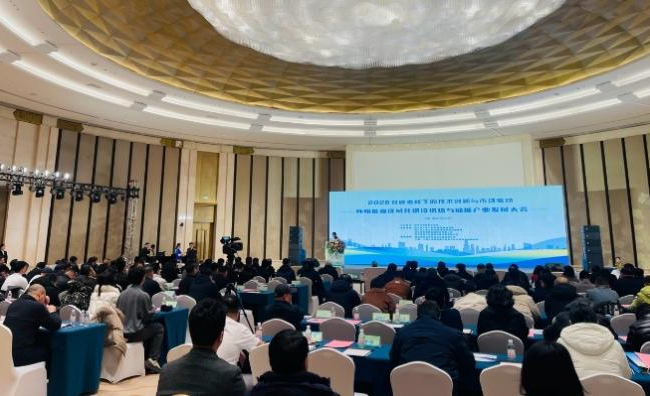
Experts and government officials gathered in Qingdao, Shandong province, on Jan 26 to discuss how environmentally friendly energy and energy storage systems can reshape district-level cooling and heating. [Photo provided to chinadaily.com.cn]
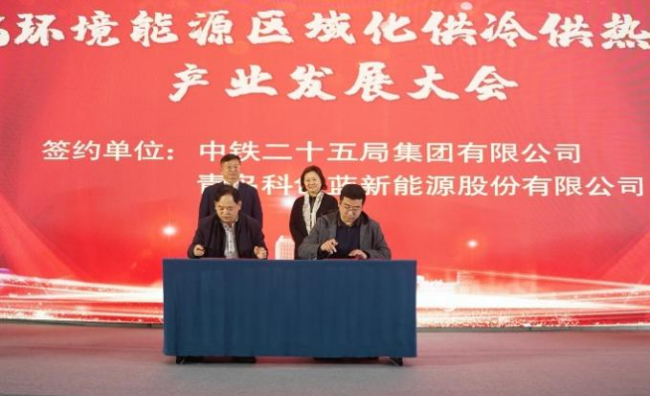
Qingdao KC Blue New Energy Co Ltd signs a strategic cooperation agreement with China Railway 25th Bureau Group Co Ltd on Jan 26. [Photo provided to chinadaily.com.cn]


 Play
Play  Play
Play 